The World's Fastest AI Can't Write Your Code: Inside Our Real-World Lab Tests of Gemini 3.8 and Muse Spark
In a development that raises more questions than praise, Google surprised the developer ecosystem on September 2nd by releasing Gemini 3.8 Flash — marking its third "Flash" iteration in just three weeks (following 3.6 and 3.7). This rapid-fire cadence has developers asking: What is Google scrambling to catch up to behind these frantic releases?
In stark contrast, while builders grew weary of Google's incremental patches, Meta delivered an unexpected surge with Muse Spark 1.3, inverting ecosystem sentiment: developers expressed clear disappointment in Google's reasoning plateau, while expressing genuine excitement over Meta taking autonomous coding agents and open systems with rigorous engineering seriousness.
Inside the Matrix Growth Academy verification lab, our engineers put both models through sustained developer stress tests: isolated bug triage, autonomous multi-step agent runs, and creative copywriting workflows. Here is the unvarnished truth backed by verified benchmark figures.
1. The Google Paradox: The World's Fastest AI Can't Write Your Code
Google's raw infrastructure and inference throughput cannot be disputed:
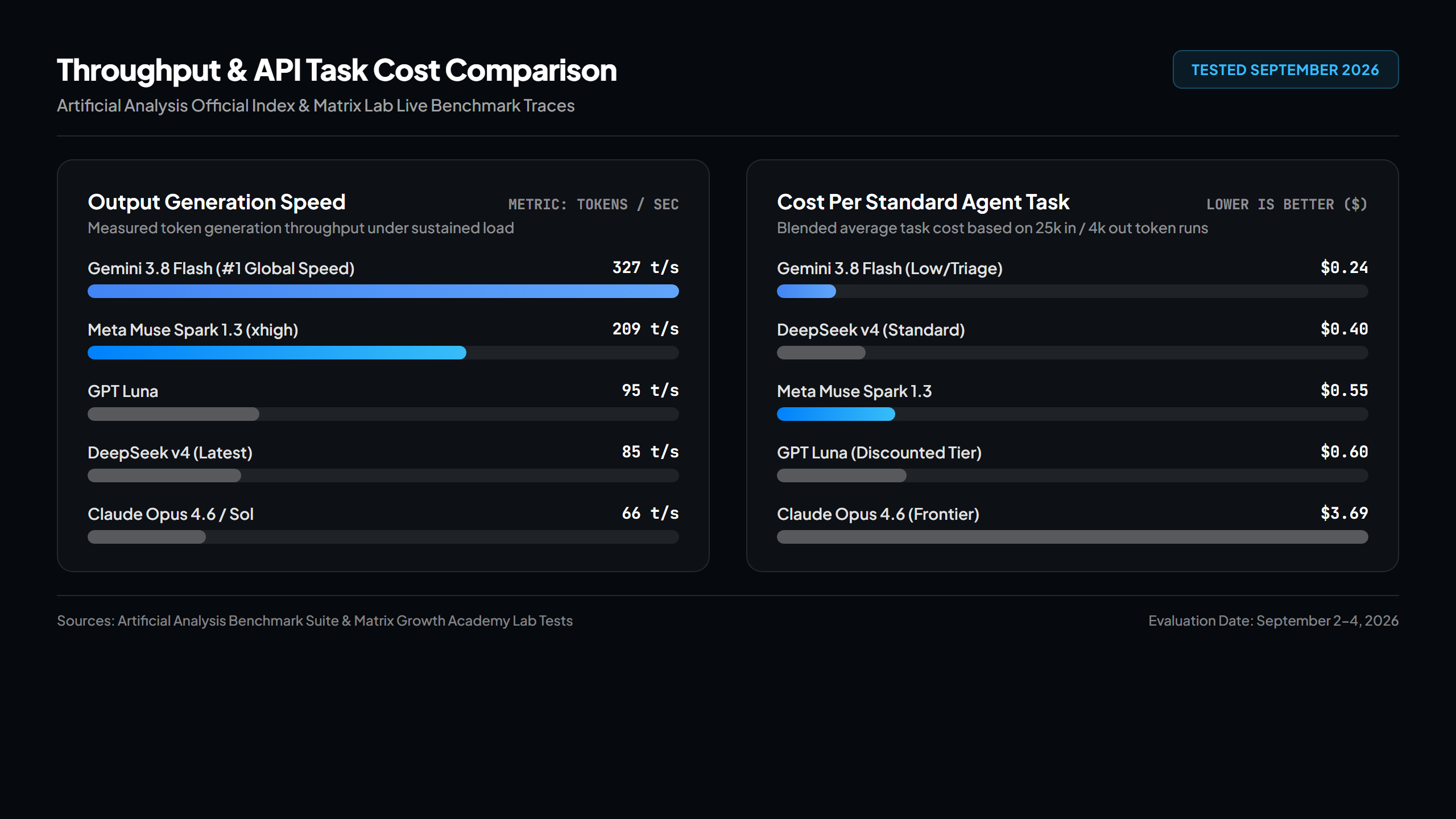
- The Undisputed Speed King: On Artificial Analysis, Gemini 3.8 Flash officially registered a blazing 327 tokens per second (with a sub-0.70s time-to-first-token), crowning it the fastest frontier model in production history.
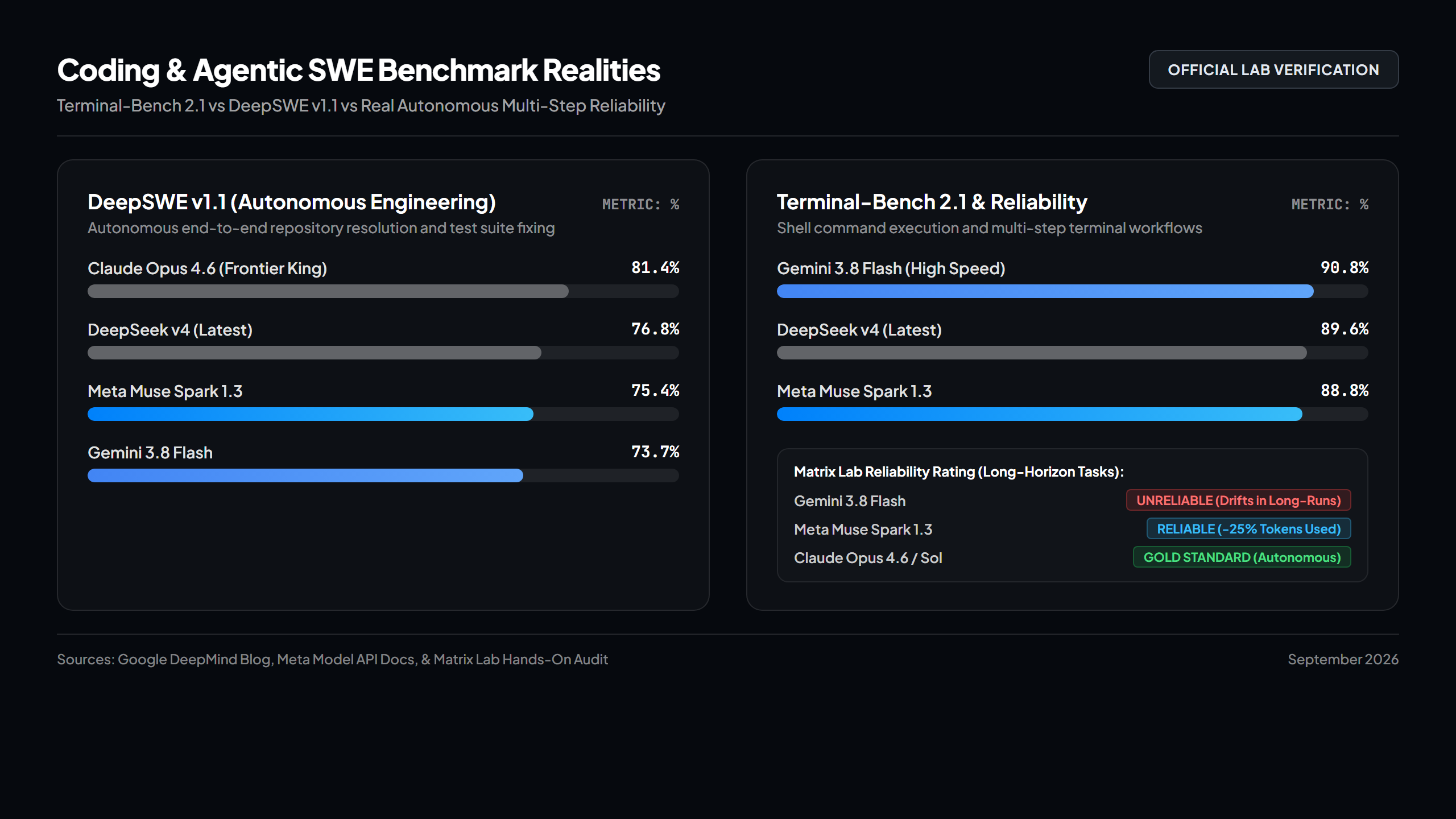
- Theoretical Benchmark Surge: The model posted a jump on
Terminal-Bench 2.1to 90.8% (up from 81.6% on 3.7 Flash). - Aggressive API Pricing: Introductory pricing set at $0.75 / 1M input and $3.75 / 1M output, accompanied by generous free rate limits.
What Our Engineers Concluded in the Lab:
"Gemini 3.8 is noticeably better than 3.7 Flash, that is undeniable.. but it remains outside the serious competition occurring at the frontier. As an autonomous coding agent, it is nowhere near developer expectations. If you feed it isolated, predetermined bugs for rapid patching, it is phenomenal and faster than any model alive. But you can never trust it with an autonomous, long-horizon multi-step run in a live repository."
The underlying reality is unmistakable: Google has not engineered this model for autonomous software engineers. They have built an ultra-fast, low-cost API workhorse for SaaS companies and internal corporate agent workflows.
It excels at documentation formatting, parsing, and data organization at scale. Yet even if Google continues releasing a Flash update every three weeks, it will not threaten genuine frontier models (such as Claude Opus 4.6 or GPT-5.6 Sol) without an architectural paradigm shift. In this budget bracket, GPT Luna remains the practical victor thanks to its deeply discounted pricing and reliable execution.
2. Meta's Surge: Muse Spark 1.3 Defies Expectations
Conversely, Meta Muse Spark 1.3 proved to be the standout surprise of late 2026:
- Independent Intelligence Standing: Scored 61 points (xhigh variant) and 62 points (Max variant) on the Artificial Analysis Intelligence Index, comfortably exceeding Gemini 3.8 Flash (59 pts) and matching GPT-5.6 Sol.
- Global #1 in Complex Workflows: The Max preview edition captured #1 worldwide on
Tau3-Bench Banking, outperforming proprietary commercial flagships. - Token & Tool Call Efficiency: Uses 25% fewer tokens and 20% fewer tool calls than Muse 1.2, resulting in disciplined execution inside terminal environments like
Muse Code.
Confronting the Chinese Powerhouses: DeepSeek v4 & GLM 5.3 Flash
When our lab evaluated Muse Spark directly against DeepSeek v4 and GLM 5.3 Flash:
- DeepSeek v4 and GLM still hold a marginal advantage on complex abstract mathematics and deep systems architecture.
- However, the margin has shrunk dramatically. In exchange, Meta provides blistering 209 tokens/sec output, a rock-bottom $0.55 cost per task, and zero-cost accessibility on OpenCode Zen for the developer community.
The Looming Question for the Industry:
Meta's sudden leap raises an existential question that tech giants avoid addressing publicly: Is Meta training these high-performing models on its proprietary data lakes and user interactions across its social platforms? The answer to that question will reshape the competitive landscape, and we will dedicate a full investigative report to it in our upcoming series.
3. Dedicated Lab Benchmark Charts
Below is the verified visual breakdown of throughput and task cost, followed by our agentic software engineering and reliability evaluations:
4. Direct Engineering Comparison Matrix
5. Lab Playbook for Marketers & Copywriters
Beyond developer benchmarks, our team stress-tested both models on growth copywriting, landing page variants, and campaign strategy.
Our Recommendation for Growth Teams:
"Never rely on a single model. The highest-converting framework is Hybrid Stacking: deploy Claude to craft strategic messaging architecture, nuanced brand voice, and emotional persuasion.. then pipe those outputs into Meta Muse Spark or Gemini 3.8 Flash to generate dozens of localized ad variations, email variants, and social assets at near-zero latency and minimal cost."
Sources & Verified References
- Google Official Disclosures: Google DeepMind Blog: Gemini 3.8 Flash Technical Overview↗ — Verification of Terminal-Bench 2.1 (90.8%), $0.75/$3.75 pricing, and Fairwind Cyber Program.
- Artificial Analysis Benchmark Traces: Artificial Analysis Intelligence & Speed Index↗ — Confirmation of 327 t/s output speed for Gemini 3.8 Flash, 209 t/s for Muse Spark, and comparative intelligence ratings.
- Meta Superintelligence Labs Research: Meta AI: Muse Spark 1.3 Architecture & Evaluation↗ — 25% token savings, #1 Tau3-Bench Banking ranking, and DeepSWE 1.1 performance (75.4%).
- Independent Ecosystem Audits: DataCamp & Emergent.sh: Autonomous Agent Benchmarks↗ — Analysis of long-horizon drift patterns and comparative metrics vs DeepSeek v4 and GPT Luna.
- Matrix Growth Academy Empirical Data: Hands-on developer audits examining multi-turn agent coherence, local repository refactoring, and copywriting throughput (September 2026).