Meta Changes the Rules of Business, Marketing, and AI Agents: Say Welcome to Muse
Meta Changes the Rules of Business, Marketing, and AI Agents: Say Welcome to Muse
For the past two years, the generative AI race looked like a high-stakes, capital-intensive duel between OpenAI and Anthropic. Both giants poured billions into training massive reasoning and coding flagships, fighting tooth and nail over software engineers, enterprise APIs, and terminal benchmarks.
Meanwhile, Meta appeared to be lingering on the sidelines—open-sourcing its Llama weights while competitors burned through venture capital on every API token.
However, Mark Zuckerberg was quietly executing an asymmetric counter-strategy—the exact playbook Elon Musk signaled with Grok Bot on X: Abandon the developer compute trap, and capture the everyday consumer.
With the official release of Muse (ai.meta.com/muse), Meta hasn't just launched another chatbot. It has signaled a seismic shift in how personal AI agents, consumer commerce, and digital marketing will operate at global scale.
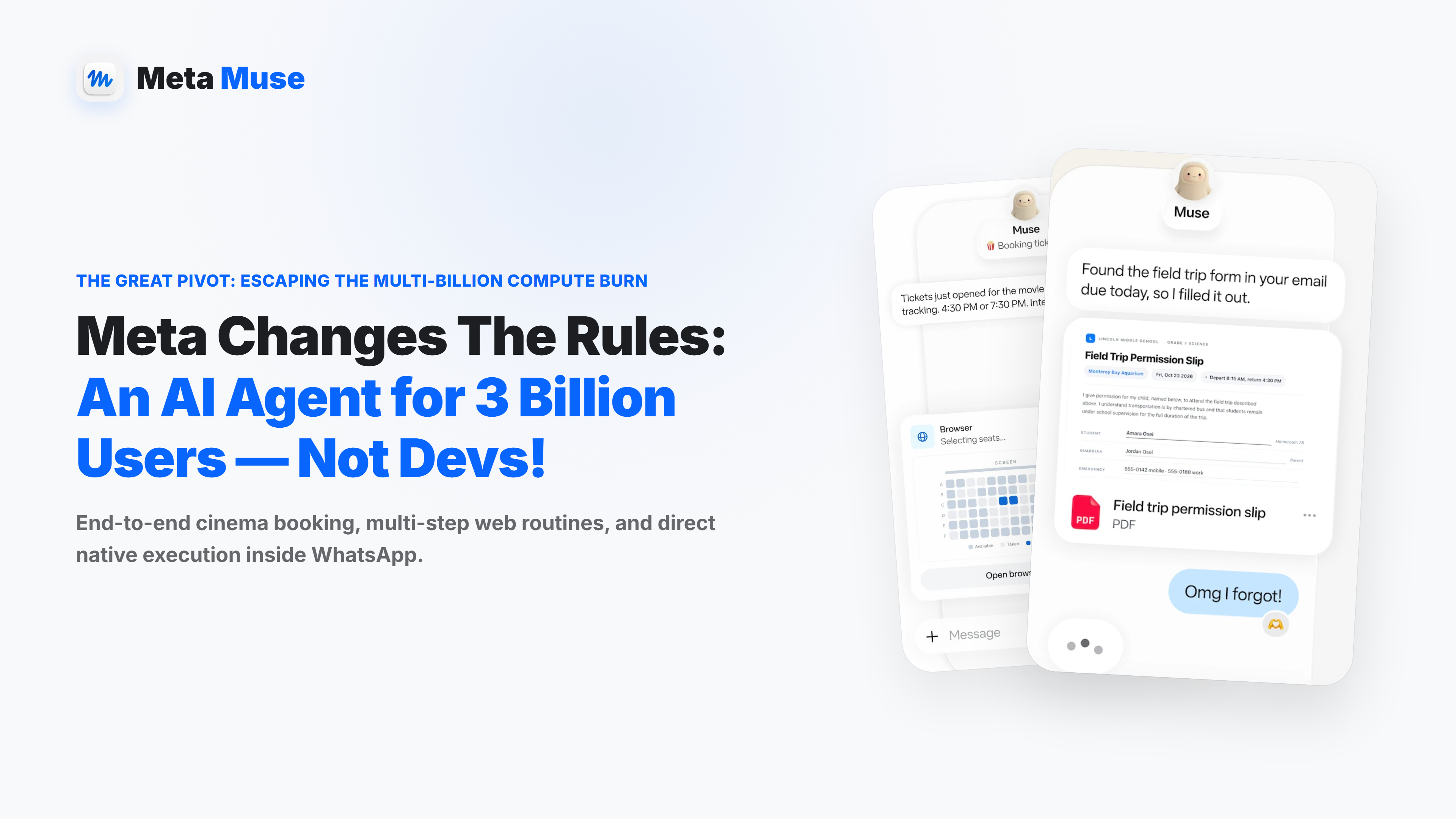
1. Unpacking Meta Muse: Features, Sandbox, and Architecture
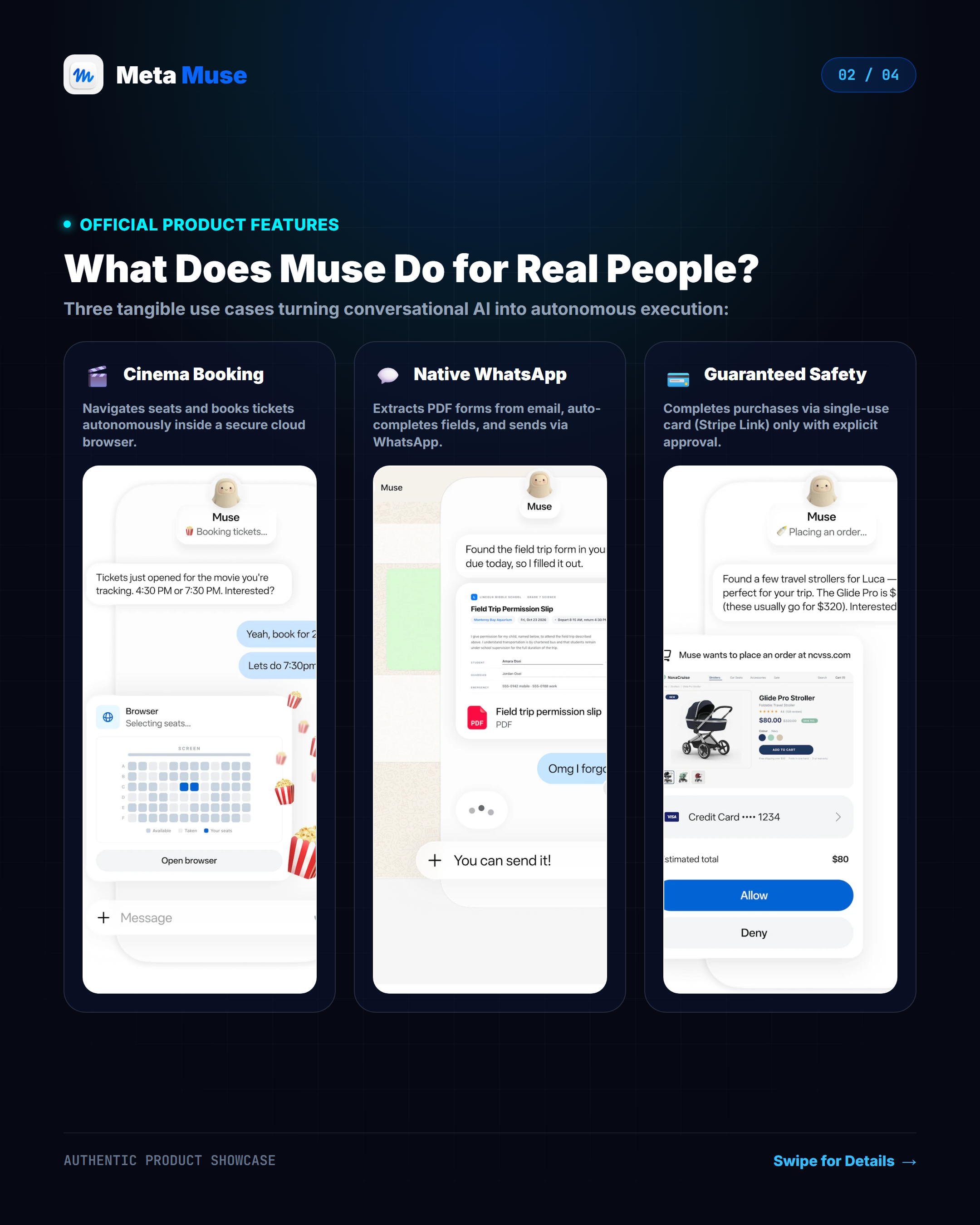
Meta describes Muse as an autonomous personal agent capable of planning and executing end-to-end web workflows on your behalf.
Regional Availability Note:
Muse is currently live exclusively in the United States for users aged 18+ via dedicated iOS and Android apps, on the web at muse.ai, and through early WhatsApp integrations. Meta plans a phased international rollout to EMEA and the Middle East in upcoming waves.Architectural Pillars:
- The Muse Spark Engine: A multimodal reasoning foundation model fine-tuned for tool manipulation, agentic planning, and computer use.
- The Muse Secure VM: Rather than running unrestrained browser scripts on host machines, Muse executes tasks inside an isolated, headless Virtual Machine with its own sandboxed browser, mitigating prompt injection and credential leaks.
- Agentic Commerce via Stripe Link: For purchasing workflows, Muse provisions single-use virtual card numbers, ensuring third-party merchants never touch the user's permanent financial instruments.
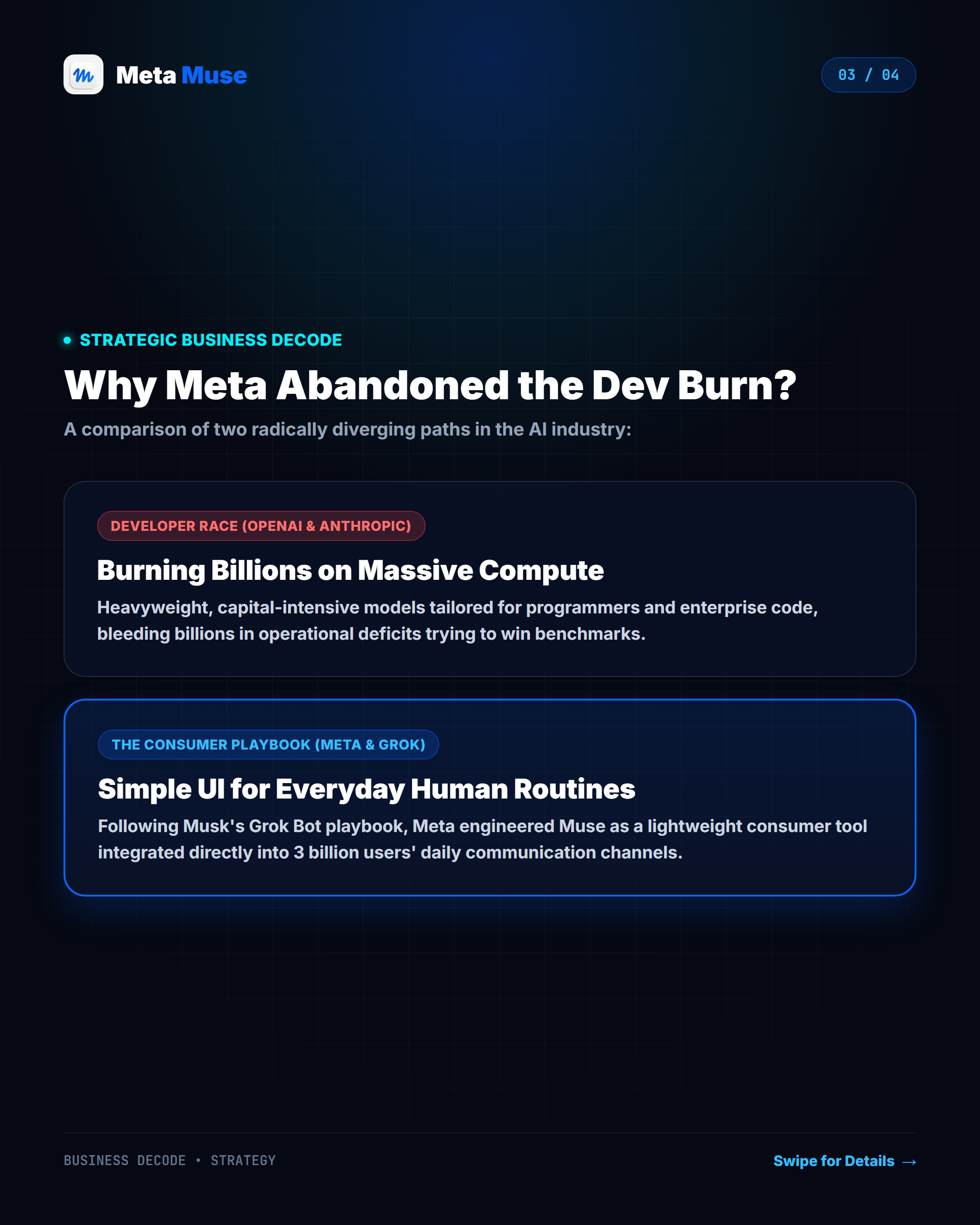
2. The Asymmetric Play: Why Meta Bypassed the Developer Arms Race
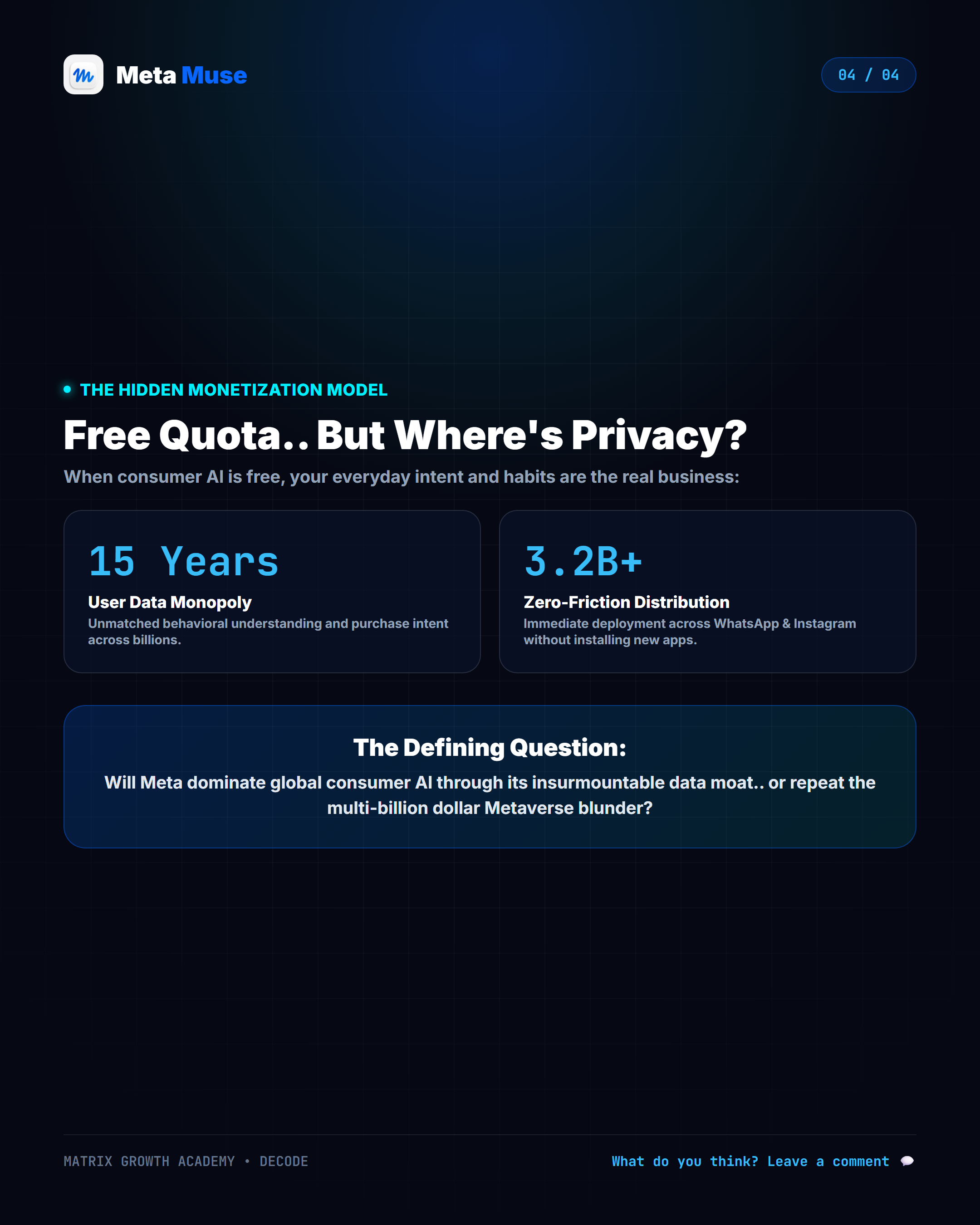
Meta controls a distribution and behavioral moat unmatched in tech history: 15 years of uninterrupted data dominance over 3+ billion daily active users across Facebook, Instagram, and WhatsApp.
While OpenAI and Anthropic prioritized:
- Deep reasoning models targeting the top 2% of technical builders.
- Staggering compute burn rates and negative margins on long-running coding loops.
Meta made a calculated pivot: Why bleed billions teaching a frontier model complex C++ architectures when 98% of the global population simply wants an assistant that books flights, negotiates utility bills, coordinates schedules, and executes multi-step web tasks?
This is the consumer agent thesis: optimize for pragmatic utility and massive reach rather than bleeding-edge code generation.
3. The Technical Anatomy: A Consumer-Grade Hermes / Grok Bot
Strip away the corporate polish, and Muse represents an architectural reality: It is the consumer-refined, closed-loop equivalent of open-source agent frameworks like Hermes, or xAI’s Grok Bot.
- Compared to Grok Bot: Muse features a significantly tighter, consumer-friendly UI/UX and native mobile ergonomics.
- Compared to Developer Models: Muse’s coding and technical synthesis capabilities are intentionally basic compared to Claude 3.7 Sonnet or OpenAI o3.
This capability cap is an intentional architectural feature, not a bug. Meta did not build Muse for systems engineers. By deliberately avoiding head-to-head competition with OpenAI and Anthropic in frontier reasoning, Meta protects its operating margins while dominating the high-volume consumer tier.
4. The Free Tier, Privacy Economics, and Meta's Long-Term Moat
Meta provides a Free Quota for lightweight everyday routines, paired with Power ($20/mo) and Max ($100/mo) compute subscriptions for high-frequency workflows.
However, the enterprise privacy assurances typical of B2B providers are noticeably absent from consumer discourse. For an advertising conglomerate with 15 years of behavioral profiling DNA, user interactions, agentic intents, and purchase workflows are the natural training fuel for next-generation models and hyper-targeted advertising.
Why Meta Could Dominate the Long Game:
- Lighter Compute Overhead: Routine browser automation requires significantly less specialized compute than frontier multi-agent reasoning loops.
- Infinite Live Feedback Loops: Hundreds of millions of consumer agent interactions produce a continuous, non-synthetic training corpus.
- Distribution Hegemony: Integrating Muse natively into WhatsApp gives Meta an immediate, zero-friction path to 2+ billion users that standalone AI startups cannot rival.
5. The Verdict: Future Hegemony or Metaverse 2.0?
In 2021, Meta committed tens of billions to the Metaverse before hardware, network infrastructure, or consumer appetite were mature.
With Muse, the dynamics are fundamentally different:
- Autonomous agents solve immediate, measurable productivity friction across everyday consumer life.
- The distribution rails (smartphones and messaging apps) are already universal.
If Meta maintains execution velocity and avoids security missteps, Muse may represent the company's definitive return to absolute tech domination. If execution falters under privacy backlash or hallucinated tasks, it risks becoming another costly chapter in consumer tech overpromise.