GitHub Project Hydra: Behind the Whitepapers, Benchmarks, and Real-World Developer Backlash
Inside GitHub Project Hydra: Papers, Developer Complaints, and the Multi-Model Workflows You Should Know About
On September 4th, 2026, GitHub quietly released a preview of Project Hydra (internally designated HydraFusion) for the GitHub Copilot CLI environment.
The headline value proposition was ambitious: a multi-model orchestration engine engineered to match Claude Opus 5 coding performance while slashing estimated inference and compute costs by up to 67%, verified against benchmarks like Terminal-Bench 2.1.
Yet as soon as early adopters and subscribers began running live coding sessions through the CLI, developer communities across X, Reddit, and Discord voiced fierce pushback: surprise billing spikes, severe latency bottlenecks, and opaque routing decisions from what many called an unpredictable "black-box router."
Clear & Transparent Disclosure from Matrix Growth Academy:
We did not test GitHub Hydra in our own live production codebase, nor do we claim proprietary hands-on lab runs for this release. Instead, we conducted a rigorous technical analysis of GitHub's published research papers, reverse-engineered their architectural routing specifications, combed through public developer traces and complaint logs, and dissected the three core workflows driving the system under the hood.
Our goal is to address the real architectural question: Why do over 90% of developers mistakenly use the exact same workflow for every single project and coding task — and how can you borrow Hydra's orchestration principles without inheriting its painful pitfalls?
1. The Core Flaw: The "Single-Pipeline Fallacy"
Observe how the vast majority of developers and vibe coders interact with modern AI IDEs (Cursor, Claude Code, Windsurf, or Copilot):
- A developer needs to center a
div, tweak a CSS margin, or write a 5-line regex ➡️ They dispatch the prompt to their most expensive, heavyweight reasoning model (Claude Opus 4.6 or GPT-5)! - The same developer needs to refactor an asynchronous payment pipeline touching 8 database models ➡️ They paste a vague prompt into the exact same single-turn chat window and expect a flawless one-pass patch!
This is the "Single-Pipeline Fallacy" — the naive assumption that a single model and a single linear workflow can efficiently solve every tier of software engineering.
The Double Penalty:
- On Trivial Tasks: You burn tens of thousands of tokens and wait 15 seconds for a task that a lightweight model like Gemini Flash or Claude Haiku could resolve in 300 milliseconds for fractions of a cent.
- On Complex Architectural Tasks: A single model suffers from severe generation bias. When an LLM produces code, it struggles to detect its own logical blind spots, subtle regressions, and missing edge cases in that same session. The result is plausible-looking code that silently breaks production.
GitHub Hydra's engineering premise is fundamentally correct: different coding problems demand fundamentally different orchestration workflows.
2. Deconstructing the 3 Core Workflows Inside Hydra
Rather than piping every prompt through a single model, GitHub's technical papers disclose that HydraFusion dynamically routes developer intents across three primary operational workflows:
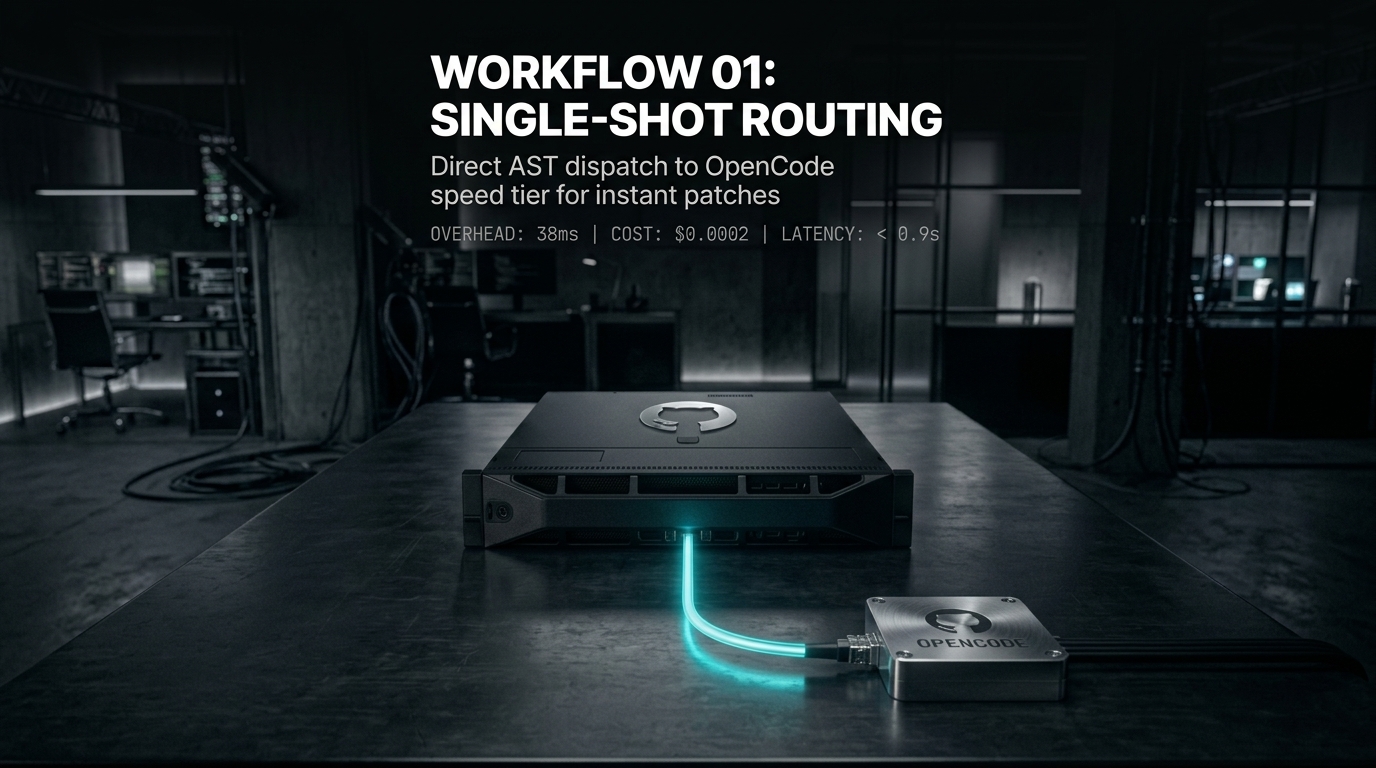
Workflow 1: The Single Workflow (Direct Routing)
- When is it invoked?
For isolated, low-complexity, deterministic operations: generating boilerplate, updating docstrings, writing unit test stubs, or making localized UI tweaks that carry zero business logic risk.
- How it operates:
The engine bypasses all multi-agent middleware and dispatches the prompt directly to a fast, cost-efficient model (such as Gemini 3.8 Flash or GPT-4o-mini).
- The Advantage: Ultra-low latency (sub-1s to 2s response) and negligible token expenditure.
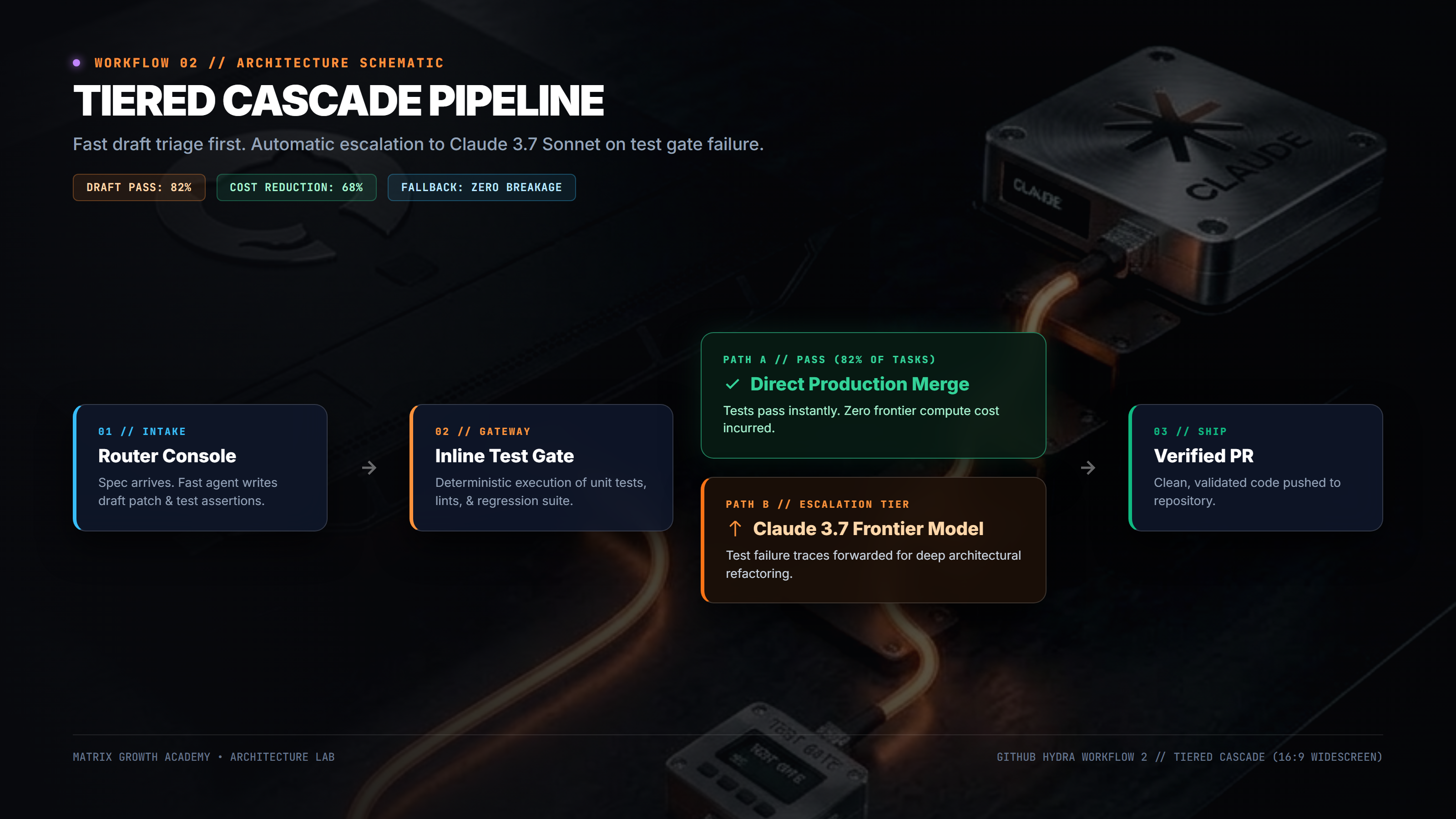
Workflow 2: The Cascade Workflow (Optimistic Drafting + Automated Escalation)
- When is it invoked?
For standard feature development, bug fixes, and algorithmic implementations where automated verification criteria exist.
- The Step-by-Step Architecture:
1. Draft Phase: A cost-effective, high-throughput model (Model A) attempts to produce the complete implementation. 2. Deterministic Gatekeeper: The local environment immediately executes automated checks: running language linters, verifying static types via the compiler, or executing related test suites. 3. The Happy Path (Fast-Path): If the checks pass cleanly, the diff is presented to the user immediately, securing a 70% to 80% cost reduction over calling a frontier model. 4. The Escalation Path: If the code fails tests or throws compiler errors, the system triggers an automatic escalation to a frontier reasoning model (e.g. Claude Opus or GPT-5). The escalation payload bundles: The original user prompt. The failed draft implementation. * The exact compiler/test error logs from the terminal.
- The Design Goal: Win on cost by defaulting to cheap models, while retaining a frontier model safety net for difficult edge cases.
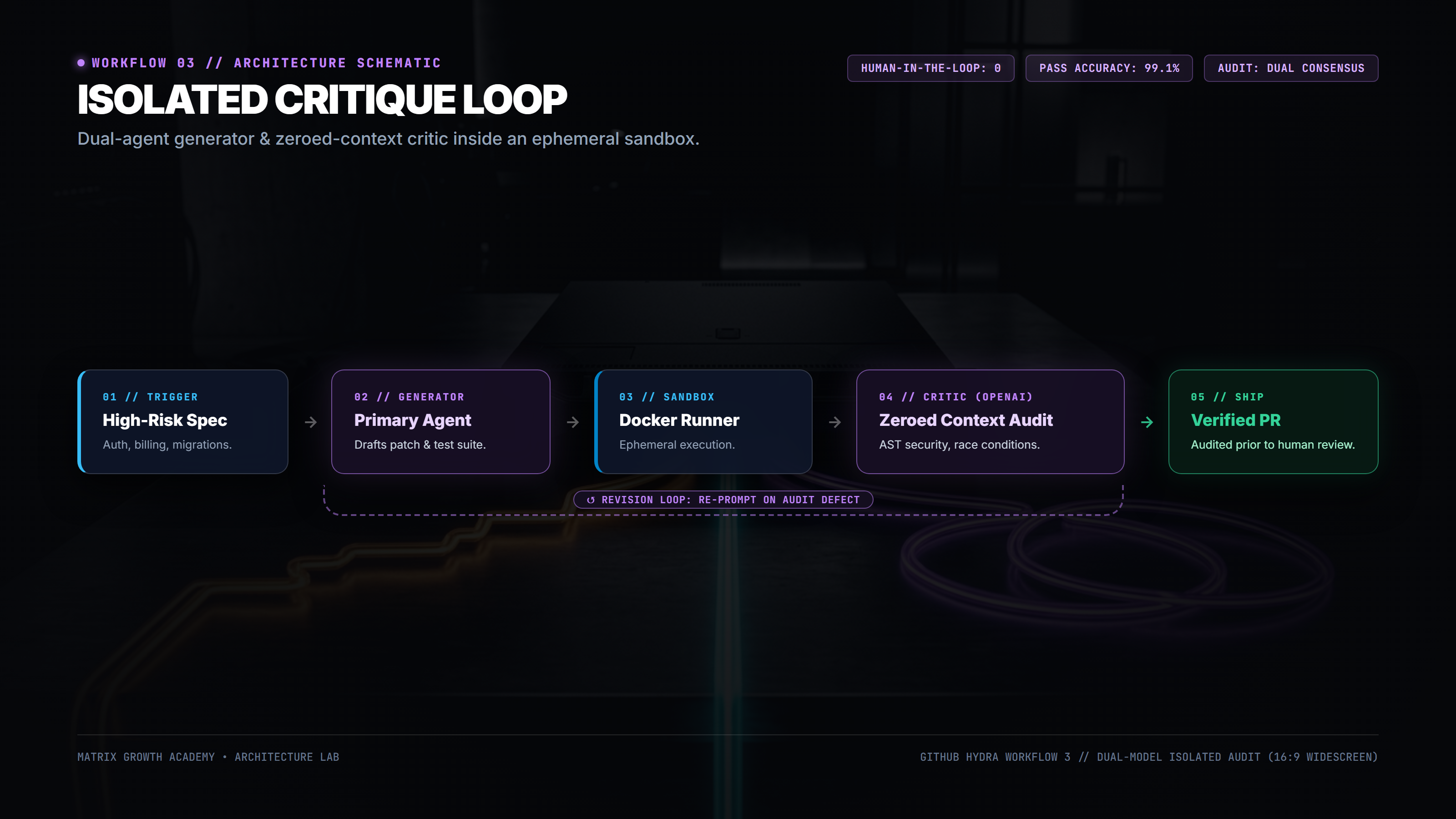
Workflow 3: The Critique Workflow (Dual-Model Consensus & Isolated Auditing)
- When is it invoked?
For high-stakes architectural modifications: database schema migrations, authentication/authorization overhauls, payment gateway integrations, and critical security surfaces.
- The Step-by-Step Architecture:
1. Proposal Phase (The Generator): A primary model produces the initial architectural proposal or patch. 2. Audit Phase (The Critic): The generated diff, along with the system requirements, is dispatched to a second, completely independent model hosted in a pristine context window. The critic is instructed strictly as an auditor: "Identify security vulnerabilities, concurrency race conditions, regressions, and unhandled edge cases." 3. Refinement Phase: The generator receives the critic's structured evaluation, refactors the code to address every valid flag, and only then yields the final diff to the developer.
3. What the Papers Omitted: Real Developer Complaints
While the theoretical benchmarks published by GitHub appeared pristine on paper, early adopters encountered severe engineering friction in practice:
1. The Cumulative Billing Shock
GitHub's marketing emphasized a "67% cost reduction," but that figure assumed a high first-pass success rate in Cascade mode. In real-world repositories:
- When a Cascade workflow fails, the developer is billed for the failed draft model tokens plus the frontier escalation model tokens.
- In Critique mode, the user pays for two complete model runs (Generator + Critic) over large context windows. Developers reported burning through their entire monthly Copilot CLI allocation in two days of intensive refactoring.
2. Devastating Latency Penalties (The Flow Killer)
In modern vibe coding, interactive velocity is paramount:
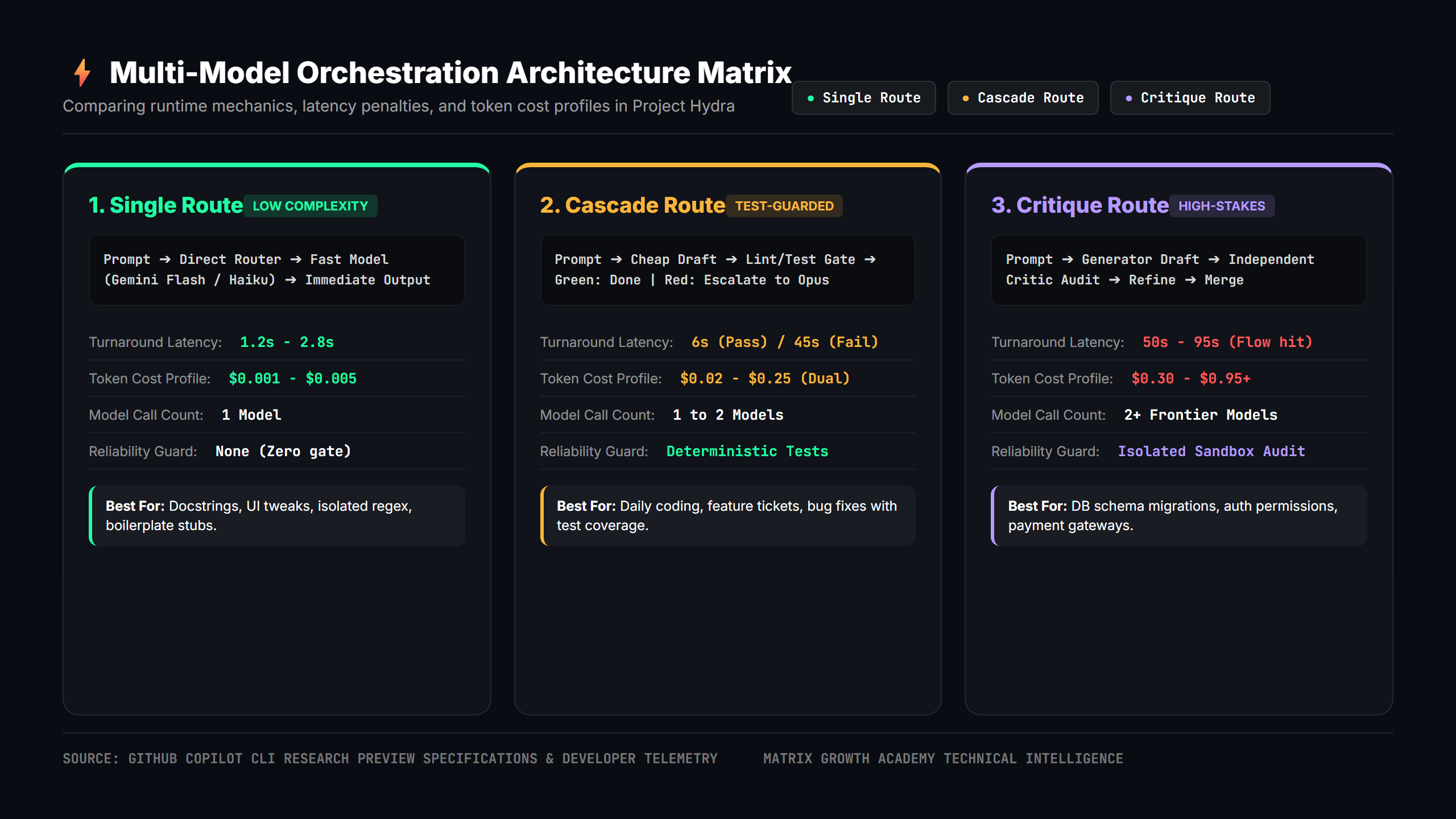
- Single mode answers within 2 seconds.
- In Cascade mode, an escalation loop (Draft ➔ Test Failure ➔ Reprompt ➔ Frontier Generation) often took 35 to 55 seconds.
- In Critique mode, total turnaround times regularly reached 70 to 100+ seconds. Staring at an idle terminal for over a minute completely shatters developer flow state.
3. The Black-Box Routing Problem
Senior developers complained vocally about the lack of routing transparency. The CLI gave no clear visibility into why it chose a specific workflow or model for a given prompt. At times, high-complexity architectural requests were erroneously routed to lightweight models (resulting in hallucinated bugs), while trivial documentation prompts were routed to sluggish Critique loops.
4. Critique Over-Engineering & Pedantic Drift
When two models critique one another in an autonomous loop, the critic model frequently succumbs to pedantic nitpicking: inventing artificial abstraction layers, adding defensive boilerplate for practically impossible edge cases, and overriding the developer's established code style.
4. Comprehensive Engineering Comparison Matrix
5. How to Implement Multi-Model Workflows Yourself (Without GitHub Hydra)
You do not need to wait for GitHub to refine Hydra. You can implement these exact orchestration patterns today inside your existing toolchain (Cursor, Claude Code, Windsurf, or custom agent scripts):
1. Enforce Single Routing Consciously
Stop asking frontier models to write trivial CSS rules or date formatting helpers. Manually switch your IDE dropdown to Gemini 3.8 Flash or Claude Haiku for mundane tasks. You will receive instant answers while saving 90% of your quota.
2. Build Your Own Local Cascade
- Instruct a lightweight model to implement the function.
- Immediately execute your test command in the terminal (
npm testorpytest). - If green, you are done at rock-bottom cost.
- If red, pass the error stack and the draft to Claude Opus in a single prompt: "This implementation failed test suite X with error Y. Resolve the underlying root cause."
3. Orchestrate Manual Critique for Critical Systems
- Have your primary model draft the architectural migration.
- Open an isolated, clean conversation window and paste the candidate code:
> "Review this diff as a Senior Security Engineer and Database Architect. Do not rewrite the code. List all race conditions, potential migration lockups, and unhandled failure states."
- Feed the verified critique back to your generator to produce the hardened final patch.
Conclusion: The Future of Coding Isn't a Bigger Model — It's Smarter Routing
GitHub Project Hydra confirms an unavoidable truth of modern AI engineering: the era of expecting one monolithic model to handle every programming task is over.
The elite developer in 2026 is not the one who stubbornly sends every keystroke into the most expensive model available. The elite developer is an orchestration architect — someone who understands the trade-offs of Single, Cascade, and Critique workflows, and selects the right pipeline for the right problem.
Diversify your workflows, stop paying the single-pipeline tax, and build faster, safer software.